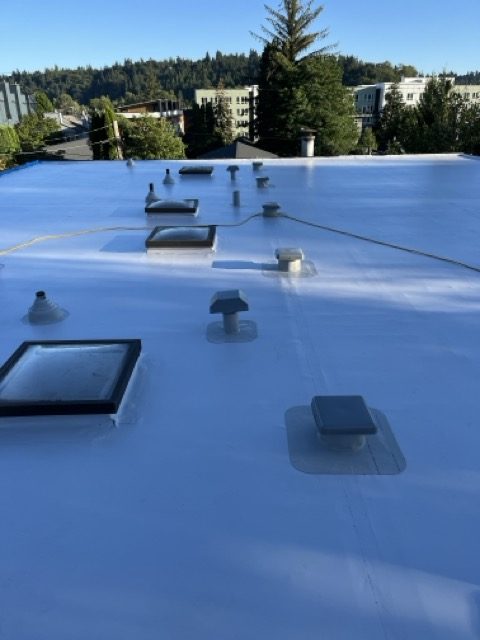
Flat roofs on townhomes are higher-risk than pitched roofs because water has nowhere to run off quickly. Shared walls, multiple roof penetrations, and ponding water mean small problems can spread between units and cause hidden leaks, rot, mold, and expensive structural damage. The good news: with the right membrane and routine maintenance, a flat townhome roof can perform reliably for decades.
A flat roof does not actually mean zero slope — it means low slope, usually a gentle pitch designed to move water toward drains. On a townhome, several factors stack the deck against you: shared roof structure between units, more rooftop penetrations (vents, plumbing stacks, HVAC), parapet walls that trap water, and drainage that depends entirely on a few drains or scuppers staying clear.
When something goes wrong on a townhome flat roof, it rarely stays contained to one spot. Water can travel along the deck and show up as a stain in a neighbor's ceiling far from the actual leak.
Standing water that does not drain within 48 hours is the classic flat-roof enemy. It adds weight, accelerates membrane aging, and finds any weak seam. In Seattle's wet season, a clogged drain can leave water pooling for weeks.
Most flat-roof leaks start at seams, around penetrations, or where the membrane meets a wall. These details are where workmanship matters most — and where cheap installations fail first.
Because the leak point and the visible damage are often far apart, water can soak into roof decking, insulation, and framing long before anyone notices a ceiling stain. By then you may be facing rotted sheathing and mold remediation, not just a patch.
| Problem | If caught early | If left unaddressed |
|---|---|---|
| Clogged drain / ponding | Cleared in minutes | Membrane failure, structural load |
| Open seam | Sealed for a few hundred dollars | Deck rot, interior damage |
| Penetration leak | Re-flashed quickly | Mold, insulation replacement, drywall |
| Aged membrane | Planned replacement | Emergency replacement + interior repairs |
The two best defenses are the right membrane and routine maintenance. A welded PVC membrane handles ponding and seam stress far better than older built-up or budget systems. Beyond that: keep drains and scuppers clear (especially before October), inspect after major storms, clear debris from treed areas 2–3 times a year, and never let foot traffic or rooftop equipment damage the surface.
We inspect and install flat roofs on townhomes and condos across Seattle, Bellevue, Kirkland, and the Eastside. If you are seeing stains, suspect a leak, or just want a condition assessment before problems start, call (425) 207-3500 or request a free estimate.
On many townhomes and condos, the roof is a shared or association-governed element, which means repairs may involve an HOA, multiple owners, or a reserve study. This adds time and process to what might otherwise be a quick fix — and that delay is exactly what lets small leaks become big ones. If you own a townhome, find out now whether your roof is your responsibility or the association's, and who to call when you spot a problem. Knowing the answer before an emergency saves precious days.
A pitched roof sheds water by gravity almost instantly. A flat roof relies on a designed drainage path — tapered insulation that creates slope, internal drains, scuppers through parapet walls, and sometimes overflow drains as a backup. Every one of those elements is a potential failure point. When a single drain clogs with leaves or debris, water backs up and ponds, and on a townhome that ponding can sit over a shared wall or unit boundary. Keeping drainage clear is the cheapest, highest-impact maintenance you can do.
Because water travels, finding the true source of a flat-roof leak takes more than looking at the stain. A proper diagnosis traces the path back uphill along the deck, inspects every seam and penetration, checks flashing at walls and parapets, and confirms the drains actually drain. We also look for prior patch jobs, which often mark the spots where the roof has failed before. Skipping this step and simply patching the nearest seam is how homeowners end up paying for the same leak two and three times.
If your flat townhome roof is relatively young and the problem is localized, a targeted repair is usually the right call. If the membrane is aging but the deck below is sound, a full membrane replacement restores decades of life. If water has been getting in for a while, you may also need to replace wet insulation and any rotted decking before the new membrane goes on. An honest contractor will tell you which category you are in instead of defaulting to the most expensive option.
Get a free, no-obligation estimate from Roof4Life. Serving Seattle, Bellevue, Kirkland & the entire Eastside since 2012.
Get Free Estimate →Find your home on a satellite map, trace the roof, and get the square footage in minutes. Free, and no site visit needed.