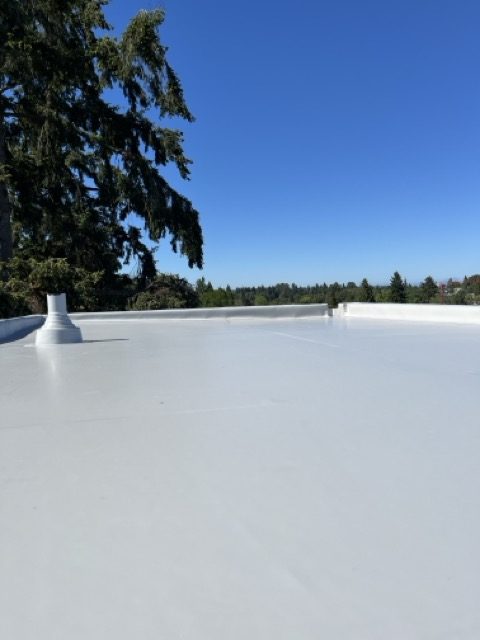
For most residential and light-commercial flat roofs in the Seattle area, PVC is the better long-term value than TPO. PVC has a longer proven track record (commercially available since 1966 versus TPO's 1991), hot-air-welded seams that create a permanent watertight bond, and superior resistance to chemicals, grease, and ponding water. TPO is cheaper up front, but PVC typically delivers a longer, lower-maintenance service life in the Pacific Northwest's wet climate.
Both PVC (polyvinyl chloride) and TPO (thermoplastic polyolefin) are single-ply, heat-reflective membranes used on flat and low-slope roofs. They look similar once installed — both are usually white or light gray and both reflect sunlight to keep buildings cooler. The important differences are in their chemistry, how they age, and how their seams are bonded.
PVC has been protecting flat roofs for decades and is considered an industry-established material. TPO is a newer formulation that was developed to offer a lower-cost alternative, and its manufacturing standards have changed several times over the years as the product matured.
| Factor | PVC | TPO |
|---|---|---|
| Track record | Proven since 1966 | Available since 1991 |
| Seam bonding | Hot-air welded, very strong | Heat welded, more variable |
| Chemical/grease resistance | Excellent | Fair |
| Ponding-water resistance | Excellent | Good |
| Fire resistance | Naturally fire-resistant | Meets code, less inherent |
| Up-front cost | Higher | Lower |
| Typical lifespan (PNW) | 25–30+ years | 15–20 years |
The number-one cause of flat-roof failure is seam separation. PVC seams are joined with hot-air welding that fuses the sheets into a single continuous membrane — a properly welded PVC seam is often stronger than the surrounding material. TPO can also be welded, but its weldability window is narrower, and field studies have documented more seam-related failures over time. In a climate like ours, where roofs face constant rain for months, seam integrity is everything.
Older PVC formulations relied on plasticizers that could migrate out of the membrane over decades, making it brittle. Modern PVC membranes — especially KEE-enhanced products — have largely solved this. TPO contains fewer plasticizers by design, which is one of its selling points, but TPO's overall field longevity still tends to trail quality PVC in real-world Pacific Northwest installations.
TPO is not a bad product — it is a reasonable choice when budget is the primary concern, on larger simple roof areas, or on structures where the roof is expected to be replaced or repurposed within 15 years. For a homeowner planning to stay in their home, or for a townhome association that wants to install once and forget it, PVC's longer life usually makes it the smarter spend.
Roof4Life installs PVC flat roofing throughout Seattle, Bellevue, Kirkland, Redmond, and the greater Eastside because it consistently outperforms TPO in our wet, mild climate. If you have a flat or low-slope roof and want to compare options for your specific building, request a free estimate and we will walk you through the trade-offs honestly.
Both PVC and TPO depend heavily on installation quality. A premium membrane installed poorly will fail faster than a budget membrane installed by a careful, certified crew. The single most important variable is seam welding: every linear foot of seam must be welded at the correct temperature and speed, then probed to confirm a continuous bond. This is why we recommend choosing your installer at least as carefully as you choose your membrane — ideally a manufacturer-certified contractor whose work carries both a workmanship warranty and the manufacturer's material warranty.
Both membranes come in reflective "cool roof" white that bounces UV and reduces summer heat gain. In hot, sunny climates that reflectivity translates into meaningful cooling savings. In the milder Seattle climate, the energy difference between PVC and TPO is modest — our cooling loads are lower than in the Sun Belt — so durability and leak resistance should drive your decision far more than reflectivity. The good news is you get the reflective benefit either way.
When people raise the old concern that PVC can become brittle as plasticizers migrate out, the modern answer is KEE (ketone ethylene ester) technology. KEE-enhanced PVC membranes lock in flexibility far longer than the PVC formulations of the 1980s, effectively neutralizing the historic weakness. If long-term flexibility is a concern for your project, ask your contractor whether a KEE-grade membrane fits your budget — it is one of the most durable single-ply options available for flat roofs anywhere.
TPO almost always wins the up-front price comparison, and for some budgets that settles it. But the smarter number to look at is cost per year of service. A PVC roof that lasts 28 years at a higher install price frequently costs less per year than a TPO roof that needs replacement at 17 years — especially once you factor in the disruption, tear-off, and potential interior repairs of an earlier second replacement. For owners who plan to hold the property, PVC's longevity usually makes it the lower lifetime cost.
Get a free, no-obligation estimate from Roof4Life. Serving Seattle, Bellevue, Kirkland & the entire Eastside since 2012.
Get Free Estimate →Find your home on a satellite map, trace the roof, and get the square footage in minutes. Free, and no site visit needed.